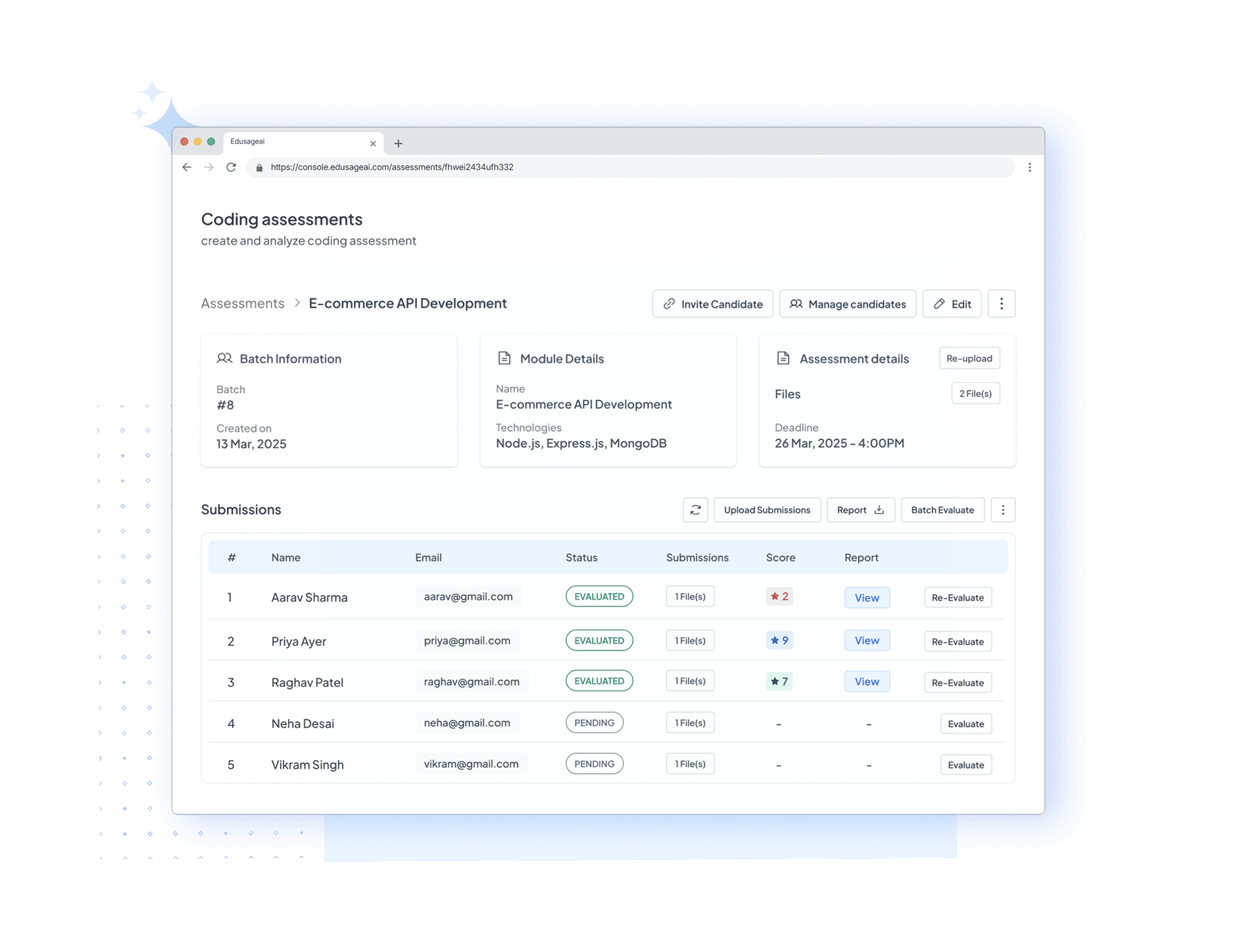
What is the best Gradescope alternative for AI grading?
EduSageAI is a strong Gradescope alternative for teachers who want AI-assisted grading across essays, assignments, rubrics, and code with teacher review built into the workflow.
Verified as of September 2026
The right Gradescope alternative depends on the work you grade most often. Gradescope is well known for structured assessment workflows such as scanned exams, bubble sheets, fixed-template PDFs, and programming assignments. If that is your core need, it can be a strong fit.
EduSageAI is the better starting point when you want a free AI grading tool for rubric-based feedback, essays, general assignments, code, and teacher-reviewed scoring. It also connects naturally to the AI grader, AI essay grader, rubric grader, and code grader workflows.
Gradescope is often evaluated for large assessment operations. EduSageAI is built for teachers who want AI feedback, flexible rubrics, and faster grading without a heavy rollout.
Use this table to decide which workflow matches your grading priorities. It is not about declaring every tool better at every task. It is about choosing the right fit.
| Factor | Gradescope | EduSageAI |
|---|---|---|
| Best fit | Large course workflows, scanned exams, bubble sheets, fixed-template PDFs, and programming assignments. | Teachers who want a free AI grading tool for essays, assignments, rubrics, and code with faster feedback. |
| Free start | Gradescope lists a Basic option and institutional plans, with some advanced workflows depending on plan and setup. | EduSageAI includes a Free Plan with 50 evaluations per month for theory and coding assignments. |
| AI feedback | Strong for grouping answers, applying rubrics, and managing repeated grading patterns in structured submissions. | Built around AI-generated rubric feedback, teacher review, and actionable comments for open-ended student work. |
| Setup style | Best when a course needs a structured assessment workflow and may already have institution support. | Best when a teacher wants to upload work, apply criteria, review results, and move quickly. |
| Content coverage | Commonly used for exams, homework, bubble sheets, and programming assignments. | Works across essays, classroom assignments, rubric grading, code, lesson planning, and differentiation workflows. |
Comparison note: Gradescope features and plan names can change. For current details, review the official Gradescope website and Gradescope pricing page.
For a college or university department, the best Gradescope alternative is the one that matches the assessment format the department actually grades. EduSageAI is the strongest fit where the workload is open-ended: essays, written exam responses, and coding assignments scored against a shared rubric, with instructor review before grades post. Gradescope remains the better tool when the core need is scanned paper exams and bubble sheets at scale.
Practically, a department rollout starts small: one instructor grades one real assignment on the Free plan, the rubric wording gets tightened based on how the AI scores compare with the instructor's own marks, and only then does the course or department move onto a paid plan. Because a rubric saved in EduSageAI can be reused across sections, the setup cost is paid once per assignment type rather than once per section. Computer science courses can score programming submissions against rubric criteria in the same account, which is why departments with both writing-heavy and code-heavy courses tend to evaluate it as a single purchase.
For teachers who grade open-ended work, the grading experience needs AI feedback, rubric clarity, and human review in the same place.
EduSageAI is designed as an AI grading assistant. Teachers can review, adjust, and approve scores instead of treating AI output as the final grade.
Use teacher-defined criteria to produce comments that explain what students did well and where they need to improve.
Move beyond one submission at a time with class-level signals that help identify weak criteria, common misconceptions, and reteaching needs.
Start as an individual teacher, then expand to a team or institution when the grading workflow has proven its value.
Many teachers searching for a Gradescope alternative are not only trying to collect submissions. They want a faster way to explain grades, keep rubric scoring consistent, and help students understand what to improve next.
EduSageAI focuses on that feedback layer. Start with the free plan, grade a real class set, compare the time saved, and decide whether your team needs more evaluations, reports, integrations, or support through the EduSageAI pricing plans.
The best Gradescope alternative for a college, university, or K-12 teacher depends on assessment format. EduSageAI fits open-ended work — essays, written exam responses, and coding assignments scored against a reusable rubric with instructor review before grades post — and starts free with 50 evaluations per month. Gradescope remains stronger for scanned paper exams and bubble sheets at scale.
Answers to common questions teachers ask when comparing Gradescope alternatives and free AI grading tools.
EduSageAI is a strong Gradescope alternative for teachers who want AI-assisted grading across essays, assignments, rubrics, and code with teacher review built into the workflow.
Yes. EduSageAI offers a Free Plan with 50 evaluations per month, including theory assignment grading and coding assignment grading.
Choose EduSageAI when your priority is rubric-aligned AI feedback, open-ended written work, faster teacher review, and a free-start workflow. Gradescope may be a better fit when your main need is structured scanned exam or large institutional assessment management.
Yes. EduSageAI supports coding assignment grading as part of the same platform used for essays, written assignments, and rubric-based evaluation.
No. EduSageAI is designed to accelerate first-pass grading while keeping teachers in control of review, score adjustments, and final decisions.
For a college or university department, the right Gradescope alternative depends on the assessment format. EduSageAI fits departments grading essays, open-ended exam answers, and coding assignments against a shared rubric, with instructor review before grades post. CoGrader fits courses centred on written assignments and AI feedback, and EssayGrader fits a writing-only workload. Gradescope itself remains the stronger choice for scanned paper exams and bubble sheets at scale.
Start with one instructor on the Free plan at 50 evaluations per month to grade a single real assignment, then move the course or department onto Basic at $10 per user per month with 200 evaluations or Premium at $25 per user per month with 1,000 evaluations. Institutions that need custom evaluation limits, a dedicated account manager, and premium support request an Enterprise quote.
Yes. EduSageAI evaluates code against teacher-defined rubric criteria and returns per-criterion scores and feedback, so a CS department can grade programming submissions in the same account used for essays and open-ended exam answers rather than adopting a separate autograder.