Can EduSageAI grade coding assignments and programming projects?
Yes. EduSageAI evaluates student code against teacher-defined rubric criteria and returns a score and written feedback for each criterion, covering Python, C++, Java, JavaScript, TypeScript, Ruby, and more. Coding assignment grading is included on every plan, starting with the Free plan at 50 evaluations per month, and the teacher reviews and adjusts the AI scores before grades are final.
How does EduSageAI's code grader work?
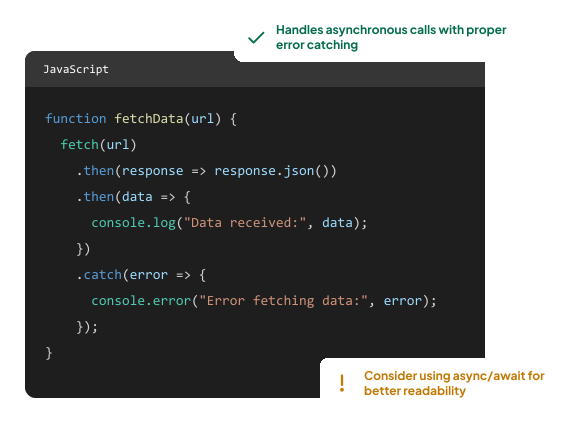
EduSageAI's code grader automatically evaluates student submissions by analyzing code structure, and assessing various quality metrics based on the problem statement. It provides detailed feedback on each aspect, helping students understand their performance comprehensively. The system evaluates code based on problem statements, assessing functionality, code quality, and technical proficiency while providing actionable insights for improvement.
How do students submit their assignments?
Students can submit their code directly through our integrated editor using a unique invite link provided by the educator. The process is streamlined and user-friendly - there's no need for manual uploads or external tools. The platform supports real-time code editing and submission, making it convenient for both students and educators.
What programming languages are supported?
Our platform currently supports a wide range of programming languages including C++, Java, JavaScript, TypeScript, Python, and Ruby. We're continuously working to expand our language support based on user demand and educational requirements. Each language implementation includes specific optimizations for accurate code evaluation.
How does the plagiarism detection feature work?
Our advanced algorithms employ sophisticated code comparison techniques to detect similarities between submissions. The system analyzes code structure, logic patterns, and implementation approaches to identify potential instances of plagiarism. This ensures academic integrity while providing educators with detailed similarity reports and evidence for any flagged submissions.
How is EduSageAI different from a test-harness autograder?
A test-harness autograder runs a fixed set of unit tests and reports pass or fail. EduSageAI grades against the rubric criteria a teacher defined — correctness, code quality, structure, documentation, efficiency — and returns an explanation for each criterion rather than a binary result. That makes it a better fit for open-ended assignments and projects where partial credit and written feedback matter more than a test suite.
Do coding evaluations use the same credits as essay and exam grading?
Yes. Code grading, essay grading, exam grading, and AI rubric generation all draw from one shared pool of evaluation credits on your plan: 50 per month on Free, 200 on Basic, 1,000 on Premium, and a custom limit on Enterprise. There is no separate coding allowance to track.
Can teachers override the AI score on a coding submission?
Yes. EduSageAI produces a first-pass evaluation, not a published grade. Teachers review every criterion score and comment, adjust anything that does not match their judgment, and decide what the student sees.
Is the platform secure and scalable?
Yes, EduSageAI is built with security and scalability in mind. We implement industry-standard security measures to protect student data and submissions. The platform can easily scale to accommodate institutions of any size, from individual classrooms to entire universities, while maintaining performance and reliability.